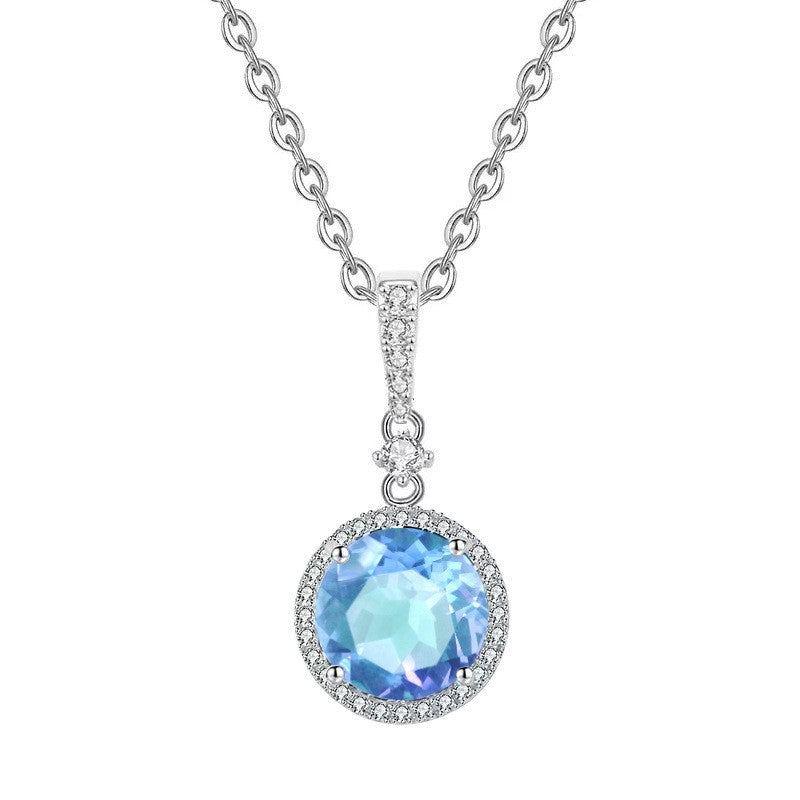
Blue Topaz Necklace Guide: Why Nearly All Blue Topaz Is Treated, and How to Judge a 925 Silver Halo Pendant
Blue topaz is one of the most popular blue gemstones for a reason: it is clear, bright and affordable compared with aquamarine or sapphire. It is also one of the stones where the honest answer about its color matters most. This guide explains where blue topaz gets its color, what the trade names mean, how it differs from aquamarine, and how to judge a piece such as our Blue Topaz Round Halo Pendant Necklace.
What topaz is
Topaz is an aluminum silicate mineral containing fluorine and hydroxyl (Al₂SiO₄(F,OH)₂). It has a Mohs hardness of 8, which makes it one of the harder gemstones in everyday jewelry, well above quartz at 7. In nature it occurs in many colors, including colorless, yellow, brown and pink. Large clean crystals are found in Brazil, Pakistan, Russia and other localities.
The honest answer about blue topaz
Natural blue topaz exists, but it is rare, usually pale and seldom seen in jewelry. Almost all of the vivid blue topaz sold today began as colorless topaz and was irradiated and then heated to create a stable blue color. This treatment is permanent, widely accepted in the gem trade, and considered a color enhancement rather than a fake, provided it is disclosed. The stone is still real topaz.
That is the case for the stone in this pendant: our product page states that, like nearly all vivid blue topaz on the market, its sky-blue shades are produced by irradiation and heat. If a seller tells you a deep, saturated blue topaz is entirely untreated, ask for proof.
Because irradiation is involved, it is natural to wonder about safety. Topaz treated in this way is held until any residual radioactivity has decayed to safe levels, and it is regulated before it can be sold in the United States. Jewelry-grade blue topaz on the market is safe to wear.
Sky, Swiss and London blue
These are trade terms for the depth of color, not different minerals:
- Sky blue: light, clear, pale aqua to bright sky blue.
- Swiss blue: brighter and more saturated than sky blue.
- London blue: a deeper, darker, steely blue.
The stone in this pendant sits in the sky-blue range, from pale aqua to bright sky blue, with natural differences from stone to stone.
Blue topaz vs. aquamarine
The two are often confused because both are clear and blue:
- Aquamarine is a variety of beryl (Mohs 7.5 to 8). Its blue is usually softer and slightly greenish, and naturally occurring, though many stones are gently heated to improve the color.
- Blue topaz is typically brighter, more saturated and cleaner, and it costs far less in larger sizes.
If you prefer a softer, more natural-looking blue, aquamarine is the choice; for a bright, clean blue at a friendlier price, topaz is the answer. More on the first in our aquamarine encyclopedia entry.
How to judge a blue topaz pendant
- Look for a clean, even color. Good topaz is transparent with few visible inclusions and a consistent tone.
- Check the cut. A well-cut faceted stone sparkles across its whole surface. A dull or "windowed" stone, where you can see through the center, is poorly cut.
- Ask about treatment. A trustworthy seller states plainly that the blue is treated, as ours does.
- Check the metal. A "925" stamp indicates sterling silver (92.5% silver).
The design: a 10 mm round with a halo
A 10 mm faceted round blue topaz sits in the center of a 925 sterling silver pendant, framed by a ring of tiny pavé-set stones, with more small accents along the bail. The halo makes the center stone look larger and more defined, and against bright silver the pale aqua to sky blue stays crisp. The pendant measures about 0.47 × 0.96 in (12 × 24.5 mm). The chain is 925 sterling silver, about 15.7 in (40 cm) plus a 2 in (5 cm) extender, so it adjusts up to about 17.7 in (45 cm).
Styling
Because the pendant is bright but compact, it works both ways: dressed up for an evening, or worn quietly every day. Blue is flattering against most skin tones and pairs naturally with white, navy, grey and denim. For a layered look, add a fine silver chain at a different length rather than a second pendant.
In crystal tradition blue topaz is linked with clear communication and calm confidence. These are cultural associations, not scientific claims.
Care: hard, but not unbreakable
Topaz is hard, yet it has perfect cleavage in one direction, which means a sharp blow along the wrong angle can split it. In a pendant, which hangs away from the knuckles and wrist, the risk is low, but it is still worth avoiding knocks.
- Wipe the silver with a polishing cloth after wearing to slow tarnish, and keep it away from perfume and chlorine.
- Clean the stone with a soft, slightly damp cloth and avoid harsh chemicals.
- Take it off for swimming, showering and exercise.
- Store it dry in a pouch, apart from other jewelry.
- Avoid leaving it in extreme heat for long periods.
Frequently asked questions
Is blue topaz real?
Yes. It is genuine topaz. The blue color is produced by treatment of colorless topaz, which is standard across the industry and is permanent.
Will the blue fade?
Commercial blue topaz is stable under normal wear. Avoid extreme heat and prolonged strong sunlight to be safe.
Is blue topaz the same as aquamarine?
No. They are different minerals. Topaz is usually brighter and more saturated, while aquamarine is typically softer in tone.
Is it safe to wear after irradiation?
Yes. Treated topaz is held until any residual radioactivity has decayed, and it is regulated before sale. Jewelry on the market is safe to wear.
Will the silver tarnish?
Sterling silver can darken naturally over time. Wiping with a silver cloth and storing it dry keeps it bright.
See sizes and photos on the product page, or browse the full 925 sterling silver collection.