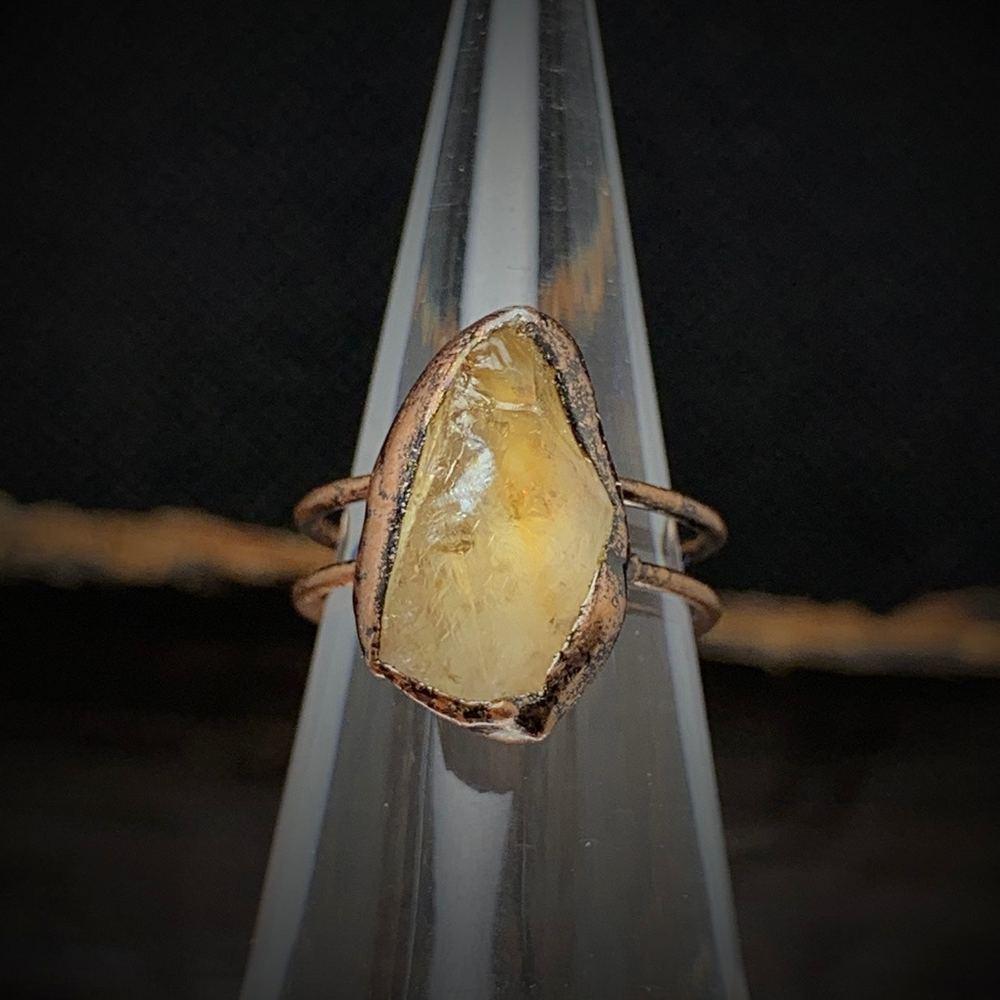
Citrine Ring Guide: Natural vs. Heat-Treated Citrine, and How to Wear a Raw Stone Ring
Citrine is one of the most searched crystals for good reason: it is bright, affordable and hard enough for everyday jewelry. It is also one of the stones where the label deserves a closer look. This guide explains what citrine actually is, how its color is produced, how to avoid imitations, and how an open raw stone ring such as our Citrine Raw Stone Adjustable Ring is meant to be worn.
What citrine is
Citrine is the yellow to orange variety of quartz (silicon dioxide). Its name comes from the French word for lemon, and the color ranges from pale lemon to honey-gold to a deeper amber-orange. It has a Mohs hardness of about 7 and no cleavage, which makes it one of the more practical colored stones for rings: it resists scratching from daily wear and does not split along internal planes like some softer gems.
The color comes from traces of iron in the crystal. How that iron sits in the structure, and what has happened to the crystal since, determines whether it shows up as the pale yellow of lemon quartz, the warm gold of a sunny citrine or the smoky brown tones of related stones.
The honest answer about heat treatment
Natural citrine exists, but it is relatively uncommon and tends to be pale yellow, sometimes with a smoky or brownish cast. Most of the deeper yellow to orange citrine in jewelry stores today started as amethyst or smoky quartz and was heated, which changes the iron's state and turns the color golden. This is a standard, widely accepted practice in the gem trade and is considered a color enhancement rather than a fake, as long as it is not misrepresented.
It is useful to know, because many people assume citrine is always natural-color. Our product page says plainly that, as with most citrine in jewelry, the color may be enhanced by gentle heat. The stone itself is real quartz.
How to tell citrine from lookalikes
- Glass: Glass imitations are common. Look for round bubbles, a molten-looking surface or a color that is perfectly even. Quartz usually has tiny natural irregularities, and feels cooler to the touch.
- Dyed quartz: Color that collects in cracks or looks unusually saturated may be dyed.
- Yellow topaz and other stones: These can look similar, but quartz is the one used for most affordable citrine.
With a raw, unpolished stone, the surface is rough by design. Look for a natural crystalline or fractured texture with translucent areas where light passes through.
What "raw" means, and why it suits a ring
Raw citrine is left as nature shaped it: an irregular outline and an uneven surface, held in a setting rather than cut into a symmetrical gem. In our ring the stone is roughly 0.63 in (1.6 cm) across, set in an antiqued copper-tone metal. Because every raw stone differs in shape and proportion, no two rings are exactly alike, and the exact tone depends on the stone you receive, from pale lemon to warm honey-gold.
The rough surface gives the ring an earthy, unforced look, and the aged metal makes the stone look timeworn in a good way. The trade-off is that a rough stone can catch on knitwear, hair and pockets, so it suits people who like a statement ring and are happy to treat it with a little care.
Sizing: how an open adjustable band works
This ring has an open band you gently squeeze or widen to fit, so you do not need an exact ring size. To fit it well:
- Slide it on your chosen finger. The ring should sit past the knuckle and not spin freely.
- If it is loose, squeeze the band slightly. If it is tight, open it a little.
- Make small changes. Metal that is bent back and forth repeatedly can weaken, so adjust once, gradually.
The open band is comfortable if your fingers swell during the day, and it makes the ring easy to gift, because you do not need to know the recipient's ring size.
Copper-tone metal and skin: what to expect
Copper-colored metals can leave a faint greenish mark on skin for some people, particularly with sweat, humidity or lotions. This is a harmless reaction of copper with skin acids and moisture, not a sign that the ring is faulty. If you notice it, keep the band dry, avoid wearing it for workouts, and wipe the inside with a soft cloth after wearing. Some people apply a thin coat of clear nail polish inside the band as a barrier.
The finish on this ring is antiqued on purpose, so it may deepen with wear. That patina is part of the design.
Styling
A raw citrine ring suits warm neutrals, denim, cream knits and gold or bronze jewelry. Wear it alone on the index or ring finger as a focal point, or stack it with a plain band on another finger. If you like a coordinated look, pair it with our other raw stone rings in different stones, or with citrine pieces from the Focus collection.
In crystal tradition citrine stands for confidence, optimism and abundance. These are cultural associations, not scientific claims, and the ring is worth wearing simply for the color.
Care
- Remove it for washing hands, swimming, showering and exercise to protect the finish.
- Avoid perfume and lotions on the metal.
- Wipe the stone with a soft, slightly damp cloth and the band with a soft dry one.
- Citrine is durable but can fade in prolonged strong sunlight, so do not leave it on a sunny windowsill.
- Store it dry and separate from other jewelry.
Frequently asked questions
Is citrine real or fake?
Citrine is a real variety of quartz. Most citrine in jewelry has been heat-treated, which is a standard and accepted practice, but the stone itself is genuine quartz rather than glass.
Will the color fade?
It is stable in normal wear, but long exposure to strong sunlight can lighten it. Store it away from direct sun.
Is it durable enough for everyday wear?
The stone is hard (about 7 on the Mohs scale). The setting is the part to protect: the antiqued finish and the open band are best worn with care, not during heavy work or workouts.
What if I do not know my ring size?
You do not need to. The open band adjusts by hand, so it fits most fingers.
Is a raw stone ring comfortable?
Yes, since the stone sits on top and the band is smooth against the skin. The rough surface faces outward, so it is the knit sleeves and pockets that need watching.
View photos and details on the product page, read more about the stone in our citrine encyclopedia entry, or see the whole ring collection.