Garnet Necklace Guide: Pyrope, Almandine and How to Choose a Red Garnet in 925 Sterling Silver
Garnet is the stone people recognize by color before they can name it: a deep, wine-dark red that looks richer indoors than in direct sun. It is also one of the most practical colored gems, hard enough for daily wear and rarely treated. This guide covers what garnet is, why two red garnets can look different, how it compares with ruby, and how to wear and care for our Garnet Wave Bar Necklace in 925 Sterling Silver.
What garnet is
Garnet is not one mineral but a group of related silicate minerals that share a crystal structure and differ in chemistry. The name comes from the Latin word for pomegranate (granatum), because small red garnet crystals look like pomegranate seeds. The main members are pyrope, almandine, spessartine, grossular, andradite and uvarovite, and they come in nearly every color except blue.
The reds most people think of as "garnet" are mainly:
- Almandine: an iron-aluminum garnet, usually deep red to violet-red, sometimes quite dark. It is the most common red garnet in jewelry.
- Pyrope: a magnesium-aluminum garnet, typically a clean, vivid red.
- Rhodolite: a blend of pyrope and almandine in a raspberry to purplish-red shade.
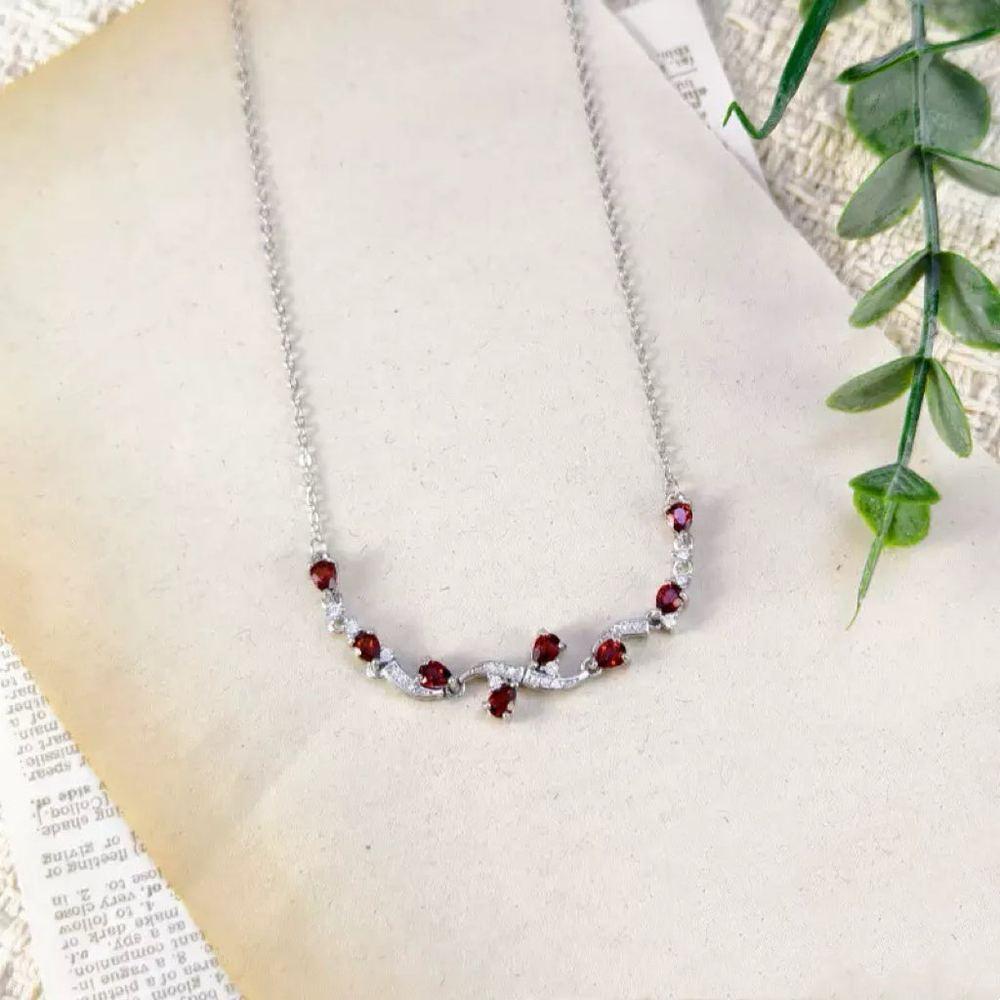
Garnets are often sold simply as "garnet" without the species, and the color is the practical guide. The stones in this necklace range from deep wine red to burgundy, with natural differences from stone to stone.
Hardness and durability
Garnet sits at about 6.5 to 7.5 on the Mohs scale, depending on the species, which puts it in the same range as quartz. Importantly, garnet has no cleavage, so it does not split along internal planes the way topaz or labradorite can. Together these make it a dependable stone for everyday jewelry, including pieces worn close to the hands.
Is garnet treated?
In general, red garnet is not routinely treated. Unlike blue topaz, whose color is created by treatment, or citrine, which is often heated, the color of red garnet is usually natural. That is part of its appeal as an honest, straightforward stone. As with any natural material, tone and clarity vary between stones.
Garnet vs. ruby
The two are often compared because both are red:
- Ruby (corundum, Mohs 9) is usually a more intense, glowing red and costs far more, especially in clean stones.
- Garnet is typically a deeper, darker, slightly brownish or purplish red, and is far more affordable, which is why it can be used in clusters or lines of stones, as in this necklace.
Neither is a substitute for the other; garnet has its own character, a dark, velvety red rather than a bright one. You can read more in our garnet encyclopedia entry.
The design: seven stones on a wave bar
Seven small faceted garnets, each about 3 × 4 mm (0.12 × 0.16 in), follow a curved 925 sterling silver bar shaped like a wave, with tiny pavé-set accents tracing the curves between them. Rather than one large center stone, the color travels across the neckline as a continuous line. Each stone is small, so the effect is delicate: a fine sweep of deep wine red to burgundy that shifts slightly as the facets catch the light, and the curve of the bar follows the collarbone for a long, slim silhouette.
The chain is 925 sterling silver, about 15.7 in (40 cm) plus a 2 in (5 cm) extender, adjustable up to about 17.7 in (45 cm). The same design is made in amethyst, which we cover in our amethyst wave bar necklace guide.
Why a deep red looks right against silver
Dark red against bright white metal creates strong contrast: the stones look richer and more saturated than they would in yellow gold. Because the stones are small, the necklace reads as a thin red line rather than a loud accent, which is why it works with so many outfits.
Styling
- Everyday: wear it with a plain top. The red adds color without needing other jewelry.
- Evening: pair it with black or deep neutrals, and keep earrings minimal.
- Layered: add a fine silver chain at a different length, but leave the wave bar as the focal piece.
- Gifting: garnet is the birthstone for January, which makes this a natural birthday gift.
In crystal tradition garnet is associated with commitment, courage and vitality. These are cultural associations, not scientific claims.
What 925 sterling silver means
The number 925 means the metal is 92.5% silver, with the remainder usually copper for strength. Sterling silver can darken over time as it reacts with sulfur compounds in air and on skin. That is ordinary tarnish, not damage, and it wipes off.
Care
- Wipe the silver with a polishing cloth after wearing.
- Keep it away from perfume and chlorine, and take it off before swimming or showering.
- Clean the stones with a soft, slightly damp cloth and avoid harsh chemicals.
- Store it dry in a pouch, apart from other jewelry.
Frequently asked questions
Is garnet a real gemstone?
Yes. Garnet is a well-known natural gemstone family and has been used in jewelry for thousands of years.
Is garnet durable enough for everyday wear?
Yes. It is hard (about 6.5 to 7.5) and has no cleavage, which makes it one of the more dependable colored stones.
Is garnet the same as ruby?
No. They are different minerals. Ruby is harder, brighter and much more expensive, while garnet is a deeper, darker red.
Will the stones all be the same shade?
Not exactly. Natural garnets vary in tone from wine red to burgundy, so your necklace will be close to the photos but not identical.
What size is the chain?
It is about 15.7 in (40 cm) with a 2 in (5 cm) extender, so it can be worn from about 15.7 in up to about 17.7 in (45 cm).
See photos and details on the product page, browse the 925 sterling silver collection, or explore the Love collection.