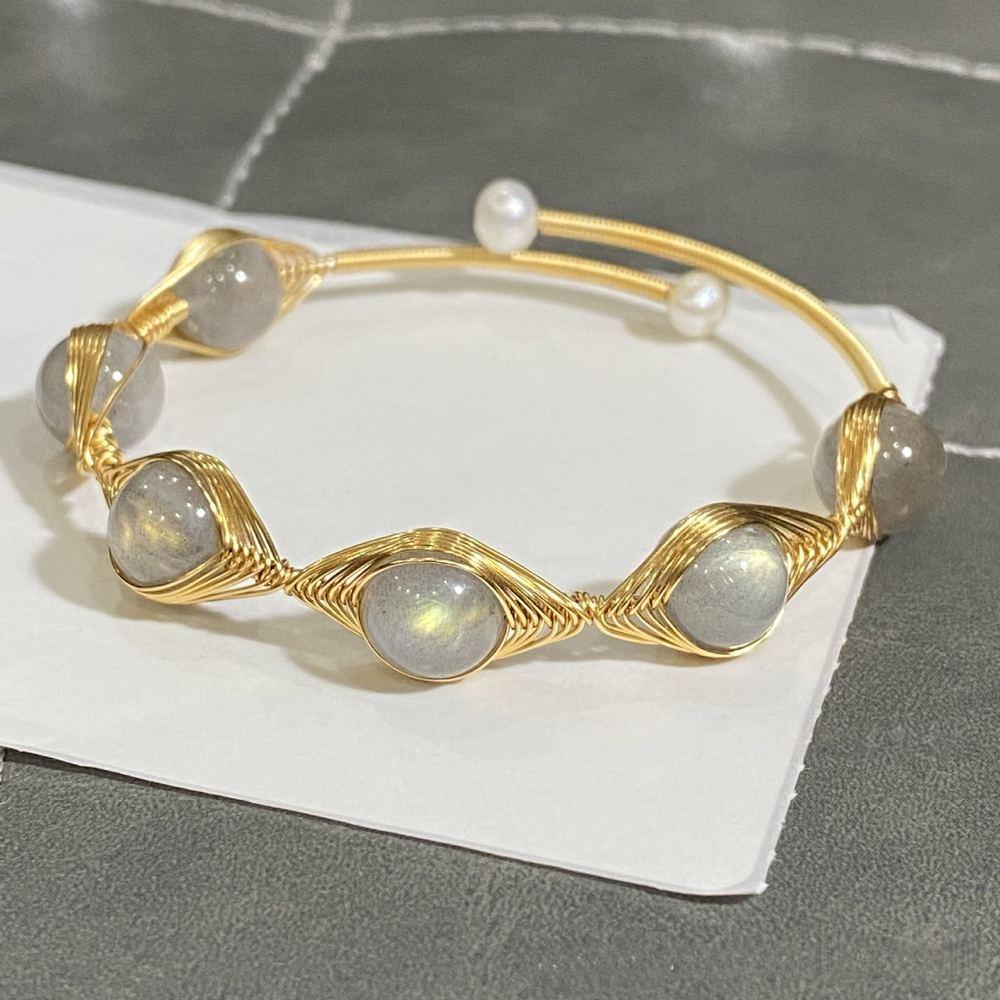
Labradorite Bracelet Guide: Labradorescence, 14k Gold-Filled Wire and How to Wear an Open Cuff
Labradorite is one of the few gemstones that does something when you move your hand. Hold it still and it can look like a plain smoky grey stone; tilt it and a sheet of electric blue, green or gold lights up and disappears. If you are searching for a labradorite bracelet, the questions that matter are what causes that flash, what separates a lively stone from a dull one, and what the metal around it is made of. This guide covers all three, using our Labradorite Wire-Wrapped Open Cuff Bracelet as the worked example.
What labradorite is
Labradorite is a member of the plagioclase feldspar family (a calcium-rich sodium-calcium aluminum silicate) with a Mohs hardness of about 6 to 6.5. It takes its name from the Labrador coast of Canada, where it was described in the 18th century, and today significant material also comes from Madagascar, Finland and other localities. Finnish material with an especially vivid, full-spectrum flash is traded as spectrolite.
It is a softer stone than quartz, and unlike quartz it has distinct cleavage planes, which means a sharp knock can chip or crack it. That is useful to know before you wear it on the wrist, which meets door frames and desks all day.
Why it flashes: labradorescence in plain terms
The color play has a name, labradorescence. Inside a labradorite crystal are extremely thin, regularly spaced layers (lamellae) formed as the feldspar cooled. Light entering the stone is reflected between these layers, and the layers interfere with one another so that only certain wavelengths come back to your eye. Which color you see depends on the spacing of the layers and the angle of the light.
Two practical consequences follow:
- The flash is directional. Each bead shows its color only at certain angles, so the bracelet seems to shimmer as your wrist moves. A bead can look grey from one side and vivid from another. That is normal, not a defect.
- The color is not on the surface. It comes from inside the stone, so it cannot rub off, but it also means a bead with cracks or heavy fractures can look flat because the layers are disrupted.
How to judge a labradorite bracelet
- Check in several lights. Look under a single bright light or in daylight and rotate your wrist slowly. Good beads flash blue, green, gold or a mix. Office lighting can make any labradorite look dull.
- Look at consistency. Across a strand, the beads rarely flash in exactly the same moment, since each is a different piece of crystal at a different angle. A few beads that flash less than the rest are expected.
- Expect grey as the base color. The body color of labradorite is typically smoky grey to near-black. Very pale, chalky beads with no flash are usually lower grade.
- Beware of unnaturally uniform, neon beads. Some stones sold as labradorite are dyed or coated to boost the flash. Natural flash has a soft, moving quality rather than a flat painted look.
The design: six beads, wrapped one at a time
The bracelet uses six polished natural labradorite beads, each wrapped by hand in 14k gold-filled wire. The wire follows the curve of the stone and adds a small sculptural detail while leaving the stone fully visible, which matters for a gem whose beauty depends on light entering it. There is no clasp: it is an open, flexible cuff you slide over the wrist, so there is nothing to fumble with and nothing to snag.
What 14k gold-filled actually means
Jewelry metal terms are used loosely, so it helps to see where gold-filled sits:
- Gold-plated: an extremely thin layer of gold applied electrochemically. It looks good new but can wear through with daily use, especially on a wrist.
- Gold vermeil: a thicker layer of gold over sterling silver, a different base metal than gold-filled uses.
- Gold-filled: a layer of karat gold mechanically bonded to a base metal core with heat and pressure. In the United States the marking requires the gold layer to make up at least 5% (one-twentieth) of the item's total weight, which is why it is typically many times thicker than plating. A "14k gold-filled" mark means the gold layer is 14-karat gold.
- Solid gold: gold throughout, at a much higher price.
Gold-filled wire holds its color for years under normal wear and does not flake the way plating can. It is not indestructible, though: chlorine, perfume and prolonged soaking can dull it over time, so a little care keeps it bright.
Fit: how an open cuff works
An open cuff does not use a ring size or a clasp. It slides on from the side or over the hand and holds by its shape. To choose well:
- Measure your wrist with a soft tape just above the wrist bone.
- Remember that the cuff is gently adjustable, so a wrist measurement does not need to be exact. If it feels slightly loose or tight, a soft squeeze or opening brings it closer to your fit.
- Adjust slowly and only as much as you need. Bending wire back and forth repeatedly can fatigue it, so make the adjustment once rather than constantly flexing the cuff.
Styling
Smoky grey with gold works with almost everything: black and white basics, denim, and the warm neutrals of autumn. The wrapped beads are bold enough to wear alone, and the open shape sits well next to a thin chain bracelet or a watch. If you wear several pieces, let the labradorite be the focal point and keep the others simple.
In crystal tradition labradorite is associated with protection, intuition and transformation. These are cultural associations rather than scientific claims, so enjoy them as part of the stone's story, not as a promise.
Care: protecting a stone that can chip
- Remove it for swimming, showering, exercising and cleaning. Water is not fatal to labradorite, but soap, chlorine and sweat dull the wire.
- Avoid ultrasonic cleaners, steam and harsh chemicals; wipe the beads with a soft, slightly damp cloth and the wire with a soft dry one.
- Take it off for heavy tasks, lifting or sports. Because the stone has cleavage, a hard knock is the most likely way to damage it.
- Store it separately in a pouch so harder stones and metals do not scratch it.
Frequently asked questions
Why does my labradorite look grey indoors?
The flash needs the right angle and a strong, direct light. Take it into daylight and turn your wrist slowly; the color appears at certain angles and then disappears again.
Is labradorite the same as moonstone?
No. Both are feldspars with a play of light, but moonstone shows a soft, floating white or blue sheen called adularescence, while labradorite shows brighter, multicolored flashes against a darker body.
Will the gold-filled wire turn my skin green?
Gold-filled is far less likely to do this than low-grade plating or costume metals, because of its thick layer of real gold. Everyone's skin chemistry differs, and perfume or heavy sweat can still affect any metal, so keep it dry and clean.
Can I adjust the cuff to fit my wrist?
Yes, gently. It is designed to flex slightly. Squeeze or open it once, slowly, rather than bending it repeatedly.
Are all the beads going to flash the same?
No. Each bead is a different piece of crystal, so tone, flash color and brightness differ from bead to bead and from one bracelet to the next. That variation is part of what makes natural labradorite interesting.
See sizes, photos and details on the product page, read the full stone reference in our labradorite encyclopedia entry, or browse the bracelet collection.