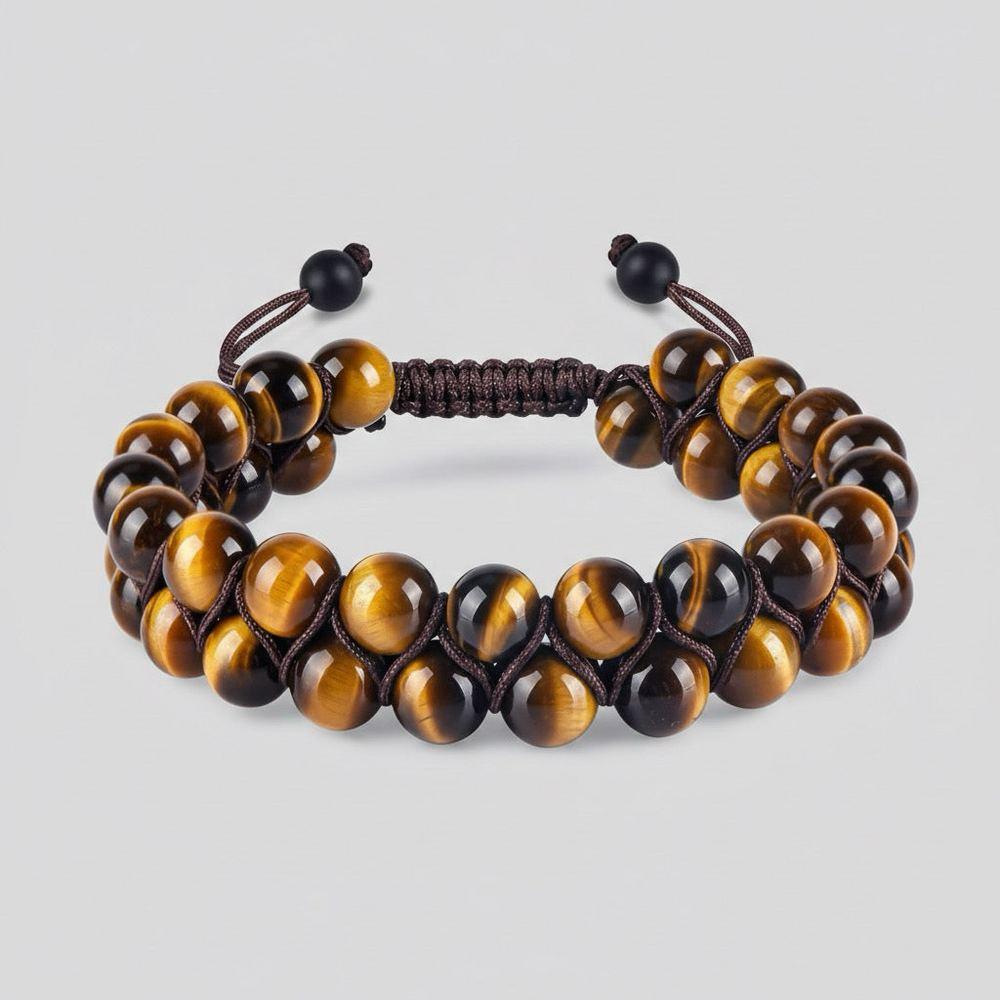
Tiger Eye Bracelet Guide: What Real Tiger Eye Is, Why It Shimmers, and How to Choose a Braided Band
Search for a tiger eye bracelet and you will find hundreds of them, ranging from carefully selected natural stone to dyed glass beads. The stone's reputation is easy to understand: golden-brown bands that seem to glow from within and slide across each bead as you move. This guide explains what tiger eye really is, what causes that moving light, how to tell it from imitations, and what to look for in a wide braided band such as our Tiger Eye Double-Row Braided Bracelet.
What tiger eye is, and how it forms
Tiger eye is a variety of quartz (silicon dioxide, Mohs hardness about 7). Its story is unusual. It begins as a fibrous blue mineral called crocidolite, a type of asbestiform amphibole. Over very long periods, silica-rich fluids moved through the rock, and the fibers were replaced by quartz while keeping their parallel, fibrous structure. As iron in the rock oxidized, the original blue turned to the golden yellow and brown we associate with tiger eye.
The result is a stone made of quartz that still carries the "ghost" of the fibers it replaced. Because the replacement is quartz, the finished polished stone is quartz, not the original fibrous mineral. Major sources include South Africa's Northern Cape and Western Australia, with smaller deposits elsewhere.
Chatoyancy: why it looks like it is alive
The moving band of light is called chatoyancy, from the French for cat's eye. The parallel fibers act like a bundle of tiny light pipes, reflecting light along a single line that sits perpendicular to the fibers. When you move the stone, that line glides across the surface, which is why a tiger eye bead seems to shimmer when your wrist turns.
On a polished bead you will see golden amber to deep brown bands, and the band positions differ from bead to bead. In a braided bracelet, where many beads sit close together and catch light from different angles, the effect becomes a continuous ripple.
Tiger eye, hawk's eye and red tiger eye
- Tiger eye: the golden to brown stone, where the original fibers have been oxidized.
- Hawk's eye: the blue-grey version, in which the fibers were replaced by quartz but largely kept their original blue color.
- Red tiger eye: deep red-brown material, most often produced by heat-treating tiger eye, a widely accepted practice that deepens the iron color.
We explain the difference in more detail in our reference on tiger eye versus hawk's eye.
How to spot a good tiger eye bracelet
- Look for a moving line, not a pattern. Rotate a bead under a single light. Real tiger eye shows a bright band that slides across the surface. Printed or painted stripes stay in place.
- Expect natural variation. Beads in a real strand differ in band width, brightness and shade. A strand where every bead looks identical may be suspect.
- Be cautious with unnatural colors. Bright blue, green or purple "tiger eye" is dyed. Natural colors are golden, amber and brown, with blue only in hawk's eye.
- Check for glass. Glass imitations often show bubbles under magnification, feel warmer or lighter than stone, and may have a sharply uniform stripe.
- Feel the weight. Quartz has a solid, slightly cool feel in the hand.
The design: two rows, hand-braided
This bracelet weaves two rows of polished natural tiger eye beads into a wide, interlocked band. It reads more like a cuff than a typical beaded bracelet, and the beads still move naturally against each other. Because there are many beads reflecting at slightly different angles, the whole band seems to flicker. A durable adjustable sliding knot closes it, so there is no clasp and no fixed size.
Sizing and fit: how a sliding knot works
- Slip the bracelet over your hand with the knot loosened.
- Pull the cord ends gently to tighten until it sits snugly but moves a little, and you can slide a fingertip beneath the band.
- To remove it, loosen the knot and slide it off. Avoid forcing a tight bracelet over your knuckles, which stresses the cord.
The sliding knot suits most wrists, and it is useful if your wrist size changes with the season or the day.
Styling
The warm brown and gold of tiger eye works with denim, leather, white shirts and the neutrals that dominate autumn and winter. A wide double-row band is confident enough to wear on its own; for a layered look, add a slim metal bracelet or a watch on the other wrist. Tiger eye also pairs naturally with gold-tone jewelry.
In crystal tradition tiger eye is linked with courage, focus and grounded confidence, which is why it is a popular choice for work and for anyone starting something new. Those are cultural associations, not scientific claims.
Care for a cord-and-stone bracelet
- Remove it before showering, swimming, washing dishes or exercising. Water and sweat weaken cord over time.
- Avoid perfume, lotions and cleaning products, which can dull the polish and discolor the cord.
- Wipe the beads with a soft, slightly damp cloth and let it dry fully; store it flat.
- Avoid leaving tiger eye in strong sun or heat for long periods, which can lighten the color of some stones.
- Quartz is tough, but a hard knock can still chip a bead.
Frequently asked questions
Is tiger eye a real gemstone?
Yes. It is a natural variety of quartz, formed when silica replaced fibrous crocidolite, and it has been cut into beads and cabochons for a very long time.
Is tiger eye safe to wear if it came from asbestos?
The original fibrous mineral has been replaced by quartz, so finished, polished tiger eye is solid quartz. The hazard associated with asbestos concerns airborne fibers from raw mining and cutting, not wearing a polished bead.
Why does the stripe move when I turn my wrist?
The light reflects off parallel fibers in the stone, producing a line of light that shifts as the angle changes. This effect is called chatoyancy.
Will tiger eye fade?
It is stable in normal wear. Prolonged strong sunlight or heat can lighten some stones, so avoid leaving it on a sunny windowsill or in a hot car.
Can I wear it every day?
Yes, with the same care you give any cord bracelet: keep it dry and take it off for heavy work, bathing and swimming.
Check sizes and photos on the product page, or browse more stones on the bracelet collection and the Focus collection.