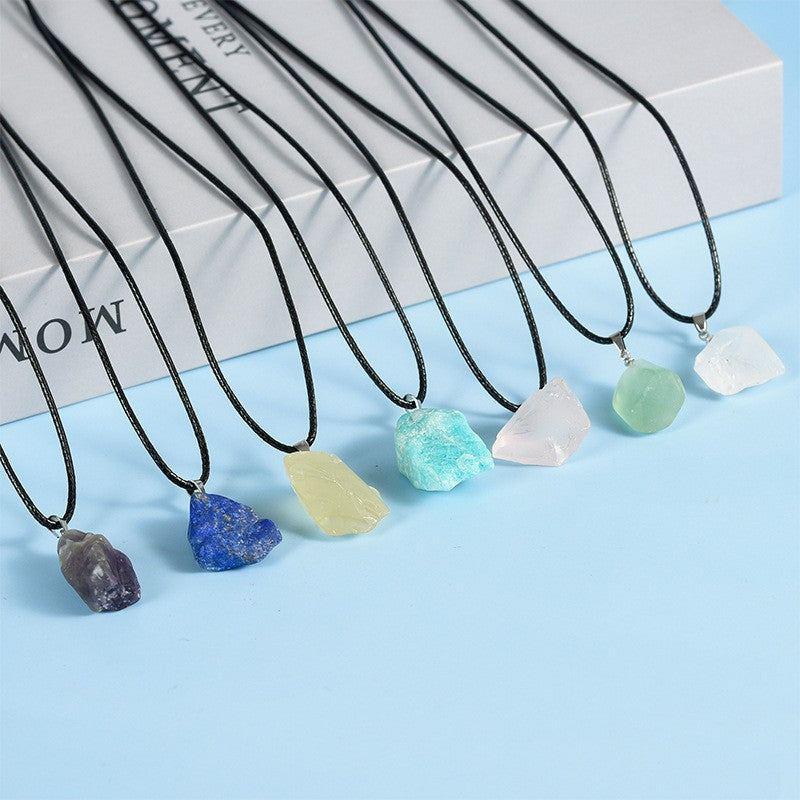
Raw Crystal Necklace Guide: What "Raw" Means, the Seven Stones Compared, and How to Care for Softer Crystals
"Raw crystal" is one of the most searched terms in crystal jewelry, yet it is rarely explained. Does raw mean uncut? Untreated? Rough? And how do you choose between seven different stones that all look appealing on a cord? Our Raw Crystal Pendant Necklace Collection offers seven stones on a simple black cord, so this guide uses it to explain what "raw" means and how the stones compare.
Raw, tumbled and polished: the difference
- Raw: the crystal is left largely as nature formed it, with natural edges, faces and surface texture. It may be lightly cleaned, but it is not ground or polished into a shape.
- Tumbled: stones are rolled in an abrasive until smooth and rounded, so they look like pebbles.
- Polished or faceted: a stone is cut and polished into a deliberate shape, such as a bead or a faceted gem.
Raw does not mean untreated or "pure" in any special sense. It describes the shape and surface only. The advantage of raw stone is character: no two pieces share the same outline, surface or pattern, and the irregularity is part of the design rather than something hidden.
The design of this pendant
One raw crystal, largely unpolished, hangs from a small silver-tone bail on a plain black cord. Nothing else competes with it, so the stone's natural shape, texture and color are the whole design. The cord is about 17.5 in (45 cm) with a 2 in (5 cm) extension, so you can fine-tune the length.
The seven stones compared
- Amethyst (quartz, Mohs 7): soft lavender to deep violet. Durable and widely loved. See the amethyst reference.
- Rose Quartz (quartz, Mohs 7): pale blush to milky pink, translucent to cloudy. See rose quartz.
- Citrine (quartz, Mohs 7): pale lemon to warm honey-gold. Much of the citrine on the market has had its color enhanced by gentle heat. See citrine.
- Lapis Lazuli (a rock, Mohs about 5 to 5.5): deep royal blue, often flecked with gold-colored pyrite and white calcite. Softer than quartz. See lapis lazuli.
- Amazonite (feldspar, Mohs about 6 to 6.5): soft mint green to blue-green, sometimes with fine pale lines.
- Clear Quartz (quartz, Mohs 7): colorless to softly cloudy, with fine internal veils. See clear quartz.
- Fluorite (Mohs 4): bands of violet, green, blue and clear. The softest of the seven, and the most likely to chip. See fluorite.
How hardness affects daily wear
Hardness decides how a stone ages. The Mohs scale ranks resistance to scratching from 1 to 10, and everyday dust is roughly Mohs 7 because it contains quartz. A stone at or above 7 resists scratching from dust, while softer stones slowly pick up fine scratches.
- Hardest group (Mohs 7): amethyst, rose quartz, citrine and clear quartz. These are the most forgiving for everyday wear.
- Middle group: amazonite (about 6 to 6.5) wears well but can scratch and has cleavage, so avoid hard knocks.
- Softer group: lapis lazuli (about 5 to 5.5) and fluorite (4) mark more easily. Wear them with care, and choose them if you like the color enough to accept gentler handling.
A pendant hangs on the chest, away from the hands and wrists, so it is subjected to far less abrasion than a ring or bracelet, and the softer stones are a reasonable choice for it, provided they are looked after.
How to choose your stone
- By color: violet (amethyst), pink (rose quartz), honey-gold (citrine), deep blue (lapis), mint green (amazonite), clear (clear quartz) or multicolor bands (fluorite).
- By durability: if you want a stone for daily wear, choose from the Mohs 7 group.
- By outfit: clear quartz and amethyst suit almost everything; lapis stands out against white and denim; citrine warms up neutrals.
In crystal tradition each stone is associated with a different theme, such as calm and intuition for amethyst, warmth and self-compassion for rose quartz, and confidence for citrine. These are cultural associations rather than scientific claims, so choose the color you enjoy.
Care for raw stones on a cord
- Keep the cord dry. Take the pendant off before showering, swimming and sleeping, since water and sweat weaken cord.
- Wipe the stone with a soft dry cloth. Avoid soaking, especially for lapis lazuli and fluorite.
- Avoid steam, ultrasonic cleaners and household chemicals, which can damage softer stones.
- Avoid knocks against hard surfaces. A raw crystal has natural edges that can chip.
- Keep it out of direct sun. Prolonged strong light can fade the color of some stones, including amethyst and rose quartz.
- Store it flat or hanging, away from other jewelry that could scratch it.
Frequently asked questions
Does raw crystal mean it is untreated?
Not necessarily. "Raw" describes the unpolished shape and surface. Some stones, such as citrine, may still have a color enhancement, which we state on the product page.
Will my pendant look like the photo?
It will be close, but not identical. Every raw crystal has its own outline, surface and pattern, so no two pendants are exactly alike.
Which stone is the most durable?
Amethyst, rose quartz, citrine and clear quartz, all at Mohs 7, are the most durable of the seven. Fluorite is the softest.
Can I adjust the length?
Yes. The cord is about 17.5 in (45 cm) with a 2 in (5 cm) extension.
Can I wear it in the shower?
We recommend not. Water weakens the cord and can damage softer stones like lapis lazuli and fluorite.
Choose your stone on the product page, browse the Calm collection, or see the full necklace collection.