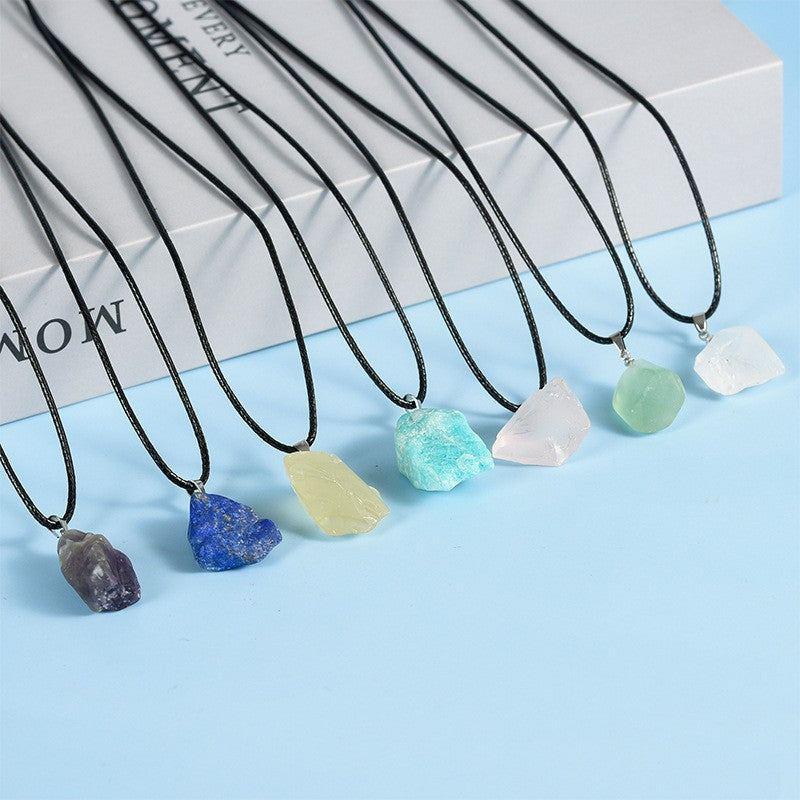
How to Tell If a Crystal Is Real: Natural, Treated, Dyed, Lab-Created or Glass
Search for "how to tell if a crystal is real" and you will find a lot of confident advice that is wrong: scratch it with a knife, drop it in hot water, check for bubbles. The truth is more nuanced. A crystal can be natural, natural but treated, lab-created, or simply glass, and each of these is legitimately sold in the market, so the real question is whether the seller tells you honestly which one it is. This guide gives you tests that actually work, explains which treatments are normal and which are not, and shows how to read a listing, so you can buy with confidence.
First, what "real" can mean
- Natural and untreated: mined and polished, with nothing added.
- Natural and treated: a real stone whose color or clarity has been improved, usually by heat or irradiation. This is common and accepted when disclosed.
- Dyed natural: a real, often pale or porous stone colored artificially. Acceptable only when it is stated.
- Lab-created (synthetic): chemically the same as the natural stone but grown in a lab. Real material, but not natural.
- Imitation: glass or plastic made to look like a stone. This is not the stone at all.
Buying well means knowing which of these a piece is, not insisting that everything must be untreated.
Treatments that are normal, when disclosed
Some very familiar stones owe their color to treatment. Citrine that is a deep orange is very often heated amethyst or smoky quartz, and natural citrine is much paler. A good deal of blue topaz is colorless topaz irradiated and then heated, and this is the standard way the vivid blue is made. Our blue topaz halo pendant and the blue topaz guide explain this openly, and we do the same on every product page. Heating is also routine for some amethyst and for many agates, which are often dyed. See the citrine ring guide for what to expect.
The problem is never treatment itself, only a seller who hides it.
Tests you can try at home
1. Look at it closely
Natural stones have small irregularities: tiny inclusions, subtle color zoning, slight differences between beads. Glass is often too perfect and uniform. Under a loupe, glass may show round gas bubbles, while natural stones show angular fractures, feathers or mineral inclusions. Perfect sameness across a whole strand is a clue to look further.
2. Feel the temperature and weight
Real stone feels cool to the touch and stays cool longer than glass or plastic, which warm up quickly in the hand. Stone also feels heavier than plastic of the same size. This is a rough test, but it is a useful one, and it costs nothing.
3. Check the color distribution
Dye tends to pool in cracks and drill holes, leaving deep color in the crevices and paler color on the surface. Color that looks neon, or uniform in a stone that is normally mottled (for example, bright blue "turquoise" with no matrix), is worth questioning. Real turquoise varies, and what is sold as turquoise is often stabilized or reconstituted, which a good seller will say.
4. Look for the signature feature
Many stones have an optical signature that is difficult to fake. Labradorite shows a flash of blue or gold that appears at certain angles. Tiger eye shows a moving band of light across its fibers. Rose quartz is typically translucent with a soft cloudiness. Rotate the stone in the light and watch whether the effect behaves as it should. Our labradorite guide and tiger eye guide describe what to look for.
5. Check for quartz-versus-glass differences
Quartz is hard, about 7 on the Mohs scale, while most glass is around 5.5. Quartz will not be scratched by a steel blade and can scratch glass, but do not try this on a finished jewelry piece, because you may damage it. It is better suited to loose stones you are willing to risk.
Tests that do not work
- Hot water or flame: can crack stones and tells you very little.
- Bubbles in the stone: some natural stones have fluid inclusions, and some glass does not have bubbles.
- "It is magnetic, so it is fake" (or the reverse): many stones are not magnetic either way. Only a few, such as hematite, have any response.
- Price alone: a low price is a warning sign for an expensive stone, but a high price does not guarantee authenticity.
Reading a listing like an expert
- Is the stone named precisely? "Amethyst" is better than "purple crystal".
- Does it mention treatment? Honest sellers say "heat-treated", "irradiated" or "dyed" when it applies.
- Does it say natural or lab-created? It should be clear which.
- Does it admit variation? Natural stones differ, so a seller promising identical pieces is suspicious.
- Is the metal stated? See our metals guide.
How we describe our stones
Each product page names the stones and notes where a common treatment applies. Many of our pieces, such as the raw crystal pendant collection, the amethyst raw stone ring and the strawberry quartz bracelet, are made from natural stones whose color, pattern and shape vary. Strawberry quartz is one to read about carefully, as the name is used for several materials, and the strawberry quartz guide explains this.
When to ask for more
If a piece is expensive, ask for the treatment details in writing. For a high-value gemstone, an independent gemological laboratory report is the only reliable answer. For everyday stone jewelry, a seller who explains treatments openly and who describes variation honestly is the best signal you can find.
Frequently asked questions
How can I tell if a crystal is real or glass?
Look for inclusions and slight irregularities, check that it feels cool and fairly heavy, and watch for the stone's signature optical effect. Glass often looks too uniform and may show round bubbles under a loupe.
Is heat-treated citrine fake?
No. Heating amethyst or smoky quartz to make citrine is a long-established practice, and the result is real quartz. It should simply be disclosed.
Is dyed stone the same as fake stone?
No, dyed stone is a real stone whose color has been added. It is only misleading if the seller does not say so.
Is lab-created the same as fake?
Lab-created stones are real material with the same chemistry, but they are not natural. They are different from glass imitations, and a seller should say which one you are buying.
Can I test a stone at home with a knife or fire?
We do not recommend it. These tests can damage the piece and are not reliable. Looking closely, feeling the weight and temperature, and asking the seller are safer.
Are all of your stones untreated?
No, and we say so. Some stones, such as citrine and blue topaz, are commonly heated or irradiated, and we note this on the product page.
Metal matters as much as stone: see our metals guide, and if you are buying for someone else, our gift guide.
Browse our natural stone jewelry, explore the crystal encyclopedia, or read more guides.